
Fitch Solutions sees RBI keeping benchmark interest rates unchanged during the fiscal to March 2022 following its decision to buy Rs 1 lakh crore of government bonds. "We had initially expected another policy rate cut to arrest the rise in government bond yields since the Union Budget announcement in February. "However, having an explicit bond purchase guidance from the RBI following the announcement of the G-SAP will also achieve a similar effect, if not even be more effective than a rate cut on capping the increase in bond yields," it said in a note. The Reserve Bank of India (RBI) held its policy repurchase (repo) rate unchanged at 4 per cent at its monetary policy meeting on April 7.

In view of rising deposit rates after the Reserve Bank of India announced a hike in repo rate*, bankers fear a pressure on lending rates, including in farm sector.
It's not the high interest rates that's affecting the economy but the policy bottlenecks.

Investors who decide to enter medium to long-duration funds should be cognisant of the risk.


India's fiscal deficit is expected to be 5.6 per cent of gross domestic product this fiscal as against the budget estimates of 4.6 per cent of GDP.
The central bank cut SLR to 23 per cent from 24 per cent.
The finance ministry wants the Reserve Bank of India (RBI) to switch its policy stance, with growth concerns occupying centre stage and inflation showing signs of moderating.
Consequently, the reverse repo rate under the LAF will remain unchanged at 7.5 per cent and the marginal standing facility (MSF) rate at 9.5 per cent.
Policy rates are not likely to increase in 2008 but a cut in repo rate too is uncertain.
More steps are necessary to accelerate speed.

The crowd at the Confederation of Indian Industry's annual general meeting and national conference 2012 merely issued a round of half-hearted applause, though finance minister Pranab Mukherjee had earlier hinted a rate cut was in the offing in the next 'half an hour'.

Listed housing finance companies (HFCs), as a group, posted a 3.7 per cent drop in second-quarter (Q2) profit year-on-year (YoY) to Rs 5,830 crore and 19 per cent sequentially on rise in interest expenses and uptick in provisions and write-offs. Operating income rose 13.7 per cent YoY to Rs 54,086 crore in Q2 of 2022-23 (FY23). Sequentially, income was up 62.3 per cent, from Rs 33,331 crore in the first quarter (Q1) of 2021-22 (FY22).

"The Monetary Policy Committee recognises that there is monetary policy space for future action. However, given the evolving growth-inflation dynamics, the MPC felt it appropriate to take a pause at this juncture," the RBI said in its fifth bi-monthly monetary policy for this fiscal.

The industry urged the central bank to consider a rate even before the next monetary policy review on July 30.
Nearly all the 43 economists surveyed over the past week expect the RBI to leave its key repo rate on hold at 8 per cent.
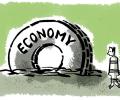
'Once the lockdown is lifted, we will see some pickup in demand.' 'And my sense is that it will be a long walk this time given that we have lost three months of economic activity.'
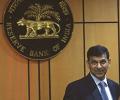
Financial services firm AnandRathi analysed the key points of the policy soon after it was announced.
Reserve Bank Governor Raghuram Rajan on Tuesday again surprised the markets and raised the key policy rate by 0.25 per cent to 8 per cent in a bid to curb inflation, a move that may translate into higher EMIs and push up the cost of borrowing for corporates.
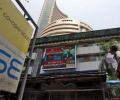
The stock markets, which had opened in the green on rate cut hopes, tumbled after the monetary policy announcement.

In the last policy review in December, RBI had decided to keep policy rate unchanged.
Be prepared to pay more every month on your home, auto and other loans.

In a bid to support revival of sectors hit most by the Covid-19 pandemic, Reserve Bank of India on Friday decided to open a separate liquidity window of Rs 15,000 crore for certain contact-intensive sectors like hotels and restaurants, tourism and aviation ancillary services.
Lending rates have to be sensitive to the policy rate, says RBI.

The Reserve Bank of India (RBI) lowered its policy repo rate by 25 basis points to 7.5 percent on Wednesday.
He said despite liquidity injection by RBI, borrowers should not expect reduction in interest rates for short- and medium-term loans. He, however, added that the measures announced by the government and RBI have starting yielding results.

Falling growth, inflation and lower fiscal deficit are expected to prompt RBI to cut rates.

Kotak Mahindra Bank was the biggest loser in the Sensex pack, sliding 2.68 per cent, followed by Tech Mahindra, Mahindra & Mahindra, Axis Bank, Hindustan Unilever, Tata Motors, Tata Consultancy Services, Bajaj Finserv, Bajaj Finance, Nestle and Titan. In contrast, NTPC, Power Grid, Larsen & Toubro, HDFC, Reliance and HDFC Bank were the gainers.
The recent hike in the rates will hurt your finances further. Time to do some stock-taking.
RBI had previously cut repo rate by 0.25% each in January and March.

Among the Sensex constituents, 20 stocks ended the session in green with HDFC Bank, Titan, Tech Mahindra, and Asian Paints being the major gainers. TCS, Maruti, Kotak Mahindra Bank and Bajaj Finserve were the other gainers. In contrast, SBI, Bharti Airtel, JSW Steel, PowerGrid, ITC and Reliance closed the trading with losses.
Over the last week, several banks have cut rates by 25 basis points, clearly not enough to fuel credit demand.
